Category Archives: Essence

How many do you take?

Last week, I had a question from a blog reader asking how many images I take from one spot while not moving my tripod.  A good question!  I will start with today’s main blog image as an example.  When I saw this scene, I looked around without a camera for what I felt was the best position.  I was looking for separation of elements, quality of reflections, background elements, distractions, white spots where the overcast sky was, etc.  I settled on a spot and took a shot.  I quickly realized there was spanish moss hanging in my frame from a close by tree. This forced me to lower my tripod enabling me to shoot underneath the moss.   Next, I realized I wanted more reach than I had with my 70-200mm lens and added my 1.7x teleconverter.  At this point I was ready for my next and final image.

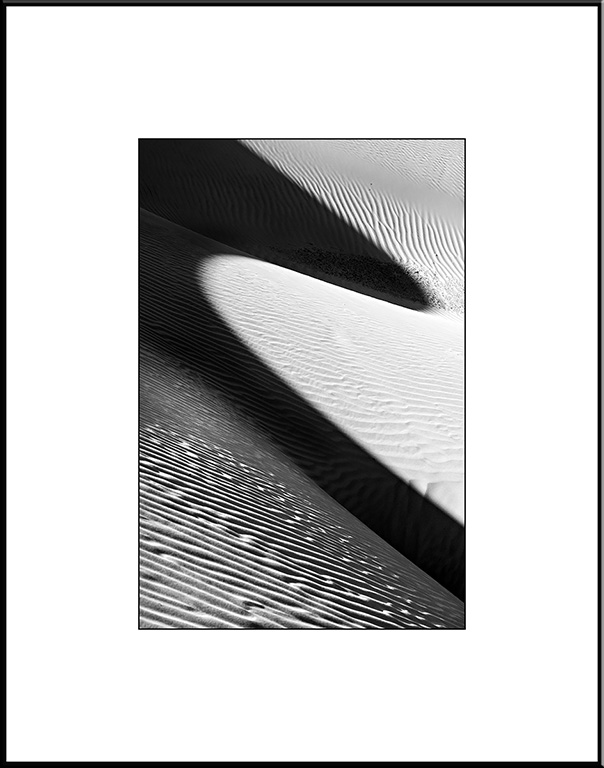
I guess the answer to Henry’s question is, I try and look at the scene without a camera or tripod first. I move left and right and sometimes up and down until I feel I’ve found the best spot or that I’m doing the hokey pokey especially well that day…..   Most times I’m looking for mergers and moving to eliminate them.  Other times I’m moving to get closer or further away or to change my perspective.   Once I find my spot, I set my tripod down and carefully assess the scene through the viewfinder.   At this point, oft times I’ll need to move my tripod a bit to finalize the composition and make the image.  As with most things in life, there are exceptions.  In the dunes for instance, I did all that I just stated, however, once I found a good spot, I found looking though my lens for various compositions more productive than moving.

I still employed all of the above, all that changed was my ability to find more compositions from one spot. This is in large part due to the subject matter.

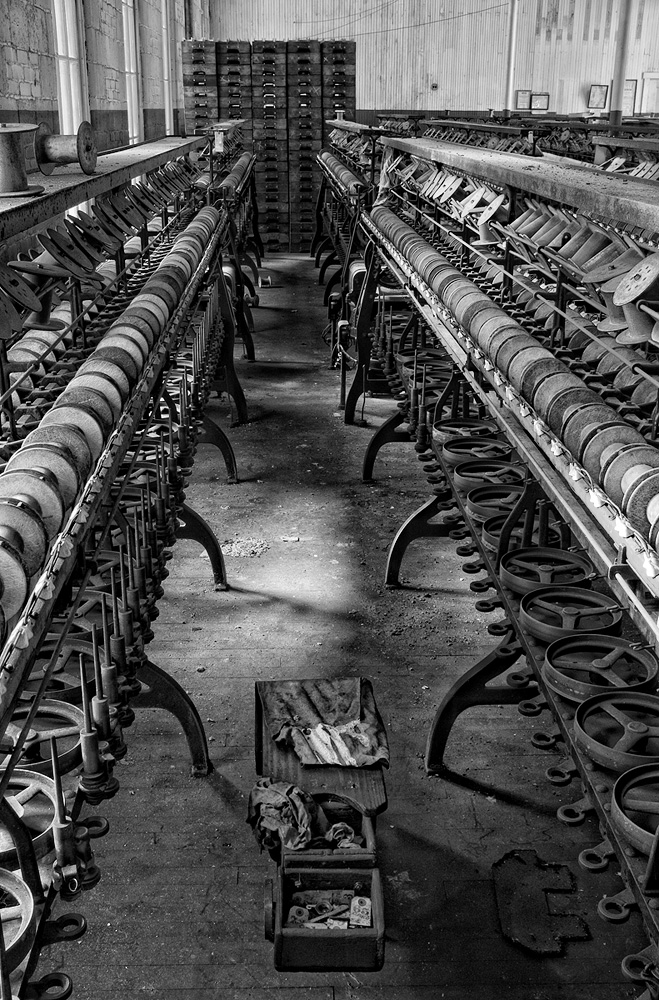
Another example would be the silk mill where I was photographing the tool caddy (see below).  In this case, I would take a shot and evaluate it on the LCD.  I would find that I missed a merger and moved the caddy just a bit until it was in the right position.   I believe I did this three times until I liked what I saw.  I also moved the caddy a couple of times to change the direction it was facing to see how I liked it that way.

Henry, I hope that helps!

Also posted in Charleston, Inspiration | Tagged , , | 5 Comments

Chasing Images


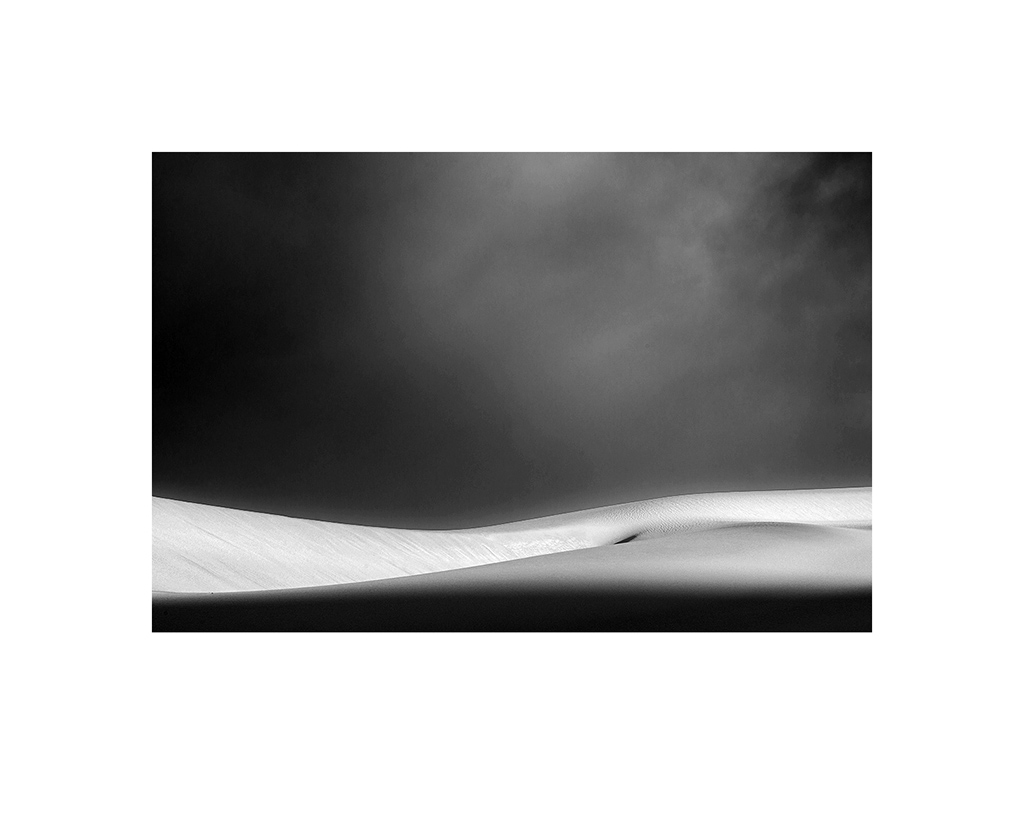
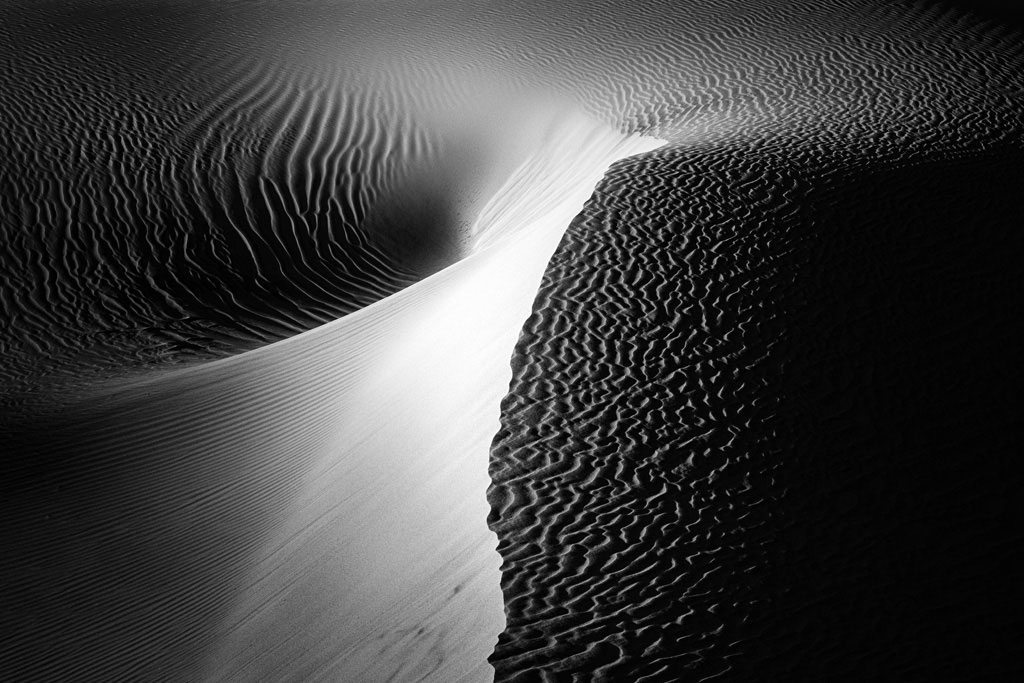
This image was created on the last morning of our workshop.  We went to a different part of the dunes, a part that I am not as attracted to.  While out there, I was fighting old familiar feelings of self doubt. You know, I’m not seeing anything out here, this is not as good as the other side, I’m not feeling inspired out here today, etc, etc… Then I stopped, I mean literally stopped and just stood still for about five minutes. Then I thought, why am I chasing images that are not here? Why am I chasing images that are like the other side of the dunes when that is not what is here? At that moment, I realized I was indeed trying to find more of the same in an area that did not offer the same. I remembered that I needed to stop chasing and start letting images come to me! Then as the sun crested the horizon, I began to see shapes forming around the ridges of the dunes and this image offered itself up. A much different image than the other dune images I’ve been posting, however, a worthy image non the less.

So, stop chasing and start allowing images to reveal themselves to you. Much like the last line in the movie August Rush where the young boy says, “the music is all around us, all you have to do is listen.” I say, the images are all around us, all you have to do is see.

Also posted in B&W, Death Valley, Inspiration, Landscape, Uncategorized | Tagged , , , | 18 Comments

Visual Flow – A Book Recommendation

A special thank you to Arthur Ransome and Chuck Kimmerle for their excellent blog posts!

A reminder, if you like the content on this blog and want to share (and I hope you do) please open the blog post by clicking on its title.  Now you’ll be able to see the sharing icons at the bottom of the blog post.  This makes it easy to share content on your favorite social media sites like Facebook, Twitter, Google+ and more.  

Today’s blog image takes us back to the dunes in search of sensuous curves.  This is a personal favorite.

I wanted to pass along a very good read.  A tremendous landscape photographer, Ian Plant has published a very good eBook titled,  VISUAL FLOW about composition.  I have found it to be as good or better than most books about this subject.  Its filled with good examples and wonderful images.  A bit pricy for an eBook but worth the money and it looks great on my iPad!  Highly recommended.  

Also posted in Arthur Ransome, B&W, Chuck Kimmerle, Death Valley, Landscape | Tagged , , , , , | 10 Comments

I Didn’t See That – A Guest Post from Chuck Kimmerle

I Didn’t See That

Text and Images – Chuck Kimmerle

There is a myth regarding landscape photography. This myth, routinely propagated in online photo forums  - and reinforced by lazy and inept photographers whose only desire is to mimic postcards they had seen in a National Park gift shop – states that, because we do not have physical control over the landscape, our genre cannot be considered art. That we, as photographers, play a subservient role in the creation of the image. In other words, the scene dictates the image, and we simply, and obediently, comply. Of course, the implication is that all of our photos will, and do, look alike. No creativity necessary.

Of course, those of us who are serious about landscape photography as an art form, who are driven, inspired, passionate and talented, and who have something personal and worthwhile to share, know this is simply not true. We are individuals, not clones. We are the driving force in the creative equation, each with our own unique stories, our own experiences, and our own emotions, all which combine to shape our respective, unique visions.

This was reinforced to me a couple weeks ago during a photo workshop in Death Valley. On no fewer than four occasions, participants said to me, “I didn’t see that” while viewing images I had made during group outings. Images shot very close to where they were standing. When I viewed their own work, I often had the same response…I didn’t see that. How, if we were standing in proximity, if we were but simple, subservient photographic clones did we see, and create, images which were so different? And how, if we were not artists, did we present these images in such vastly different ways?

I can take that one stop further. Not only would I view a particular scene differently than my comrades, I may very well see it differently than….myself. For example, on two successive mornings I was photographing with students on the dunes. On the second morning, I excitedly photographed a developing dune-scape, exploring the curves and dimensionality of this subject as the light changed, satisfied that I had found a new and worthwhile scene. However, when the light had evolved past the point of usefulness, as I was packing my gear, I discovered that it was the exact scene I had shot the day before. The same divots, the same curves, the same basic shadows. I had, on that morning, seen it differently than I had the day before. The resulting images, despite the same physical characteristics of the scene, were quite different. In each case, I saw the scene, and visualized the final images, a bit differently.


So, while landscape photographers may not have direct physical control over the elements which comprise a landscape, we are far from mere pawns. Through the filters of our respective backgrounds, biases, personalities, feelings, visions, intentions, etc, we can each see and create as  individuals. It is only after the photography is done, while sharing our images with colleagues, that we are exactly alike, each, in turn, repeating…I didn’t see that.

Chuck


To see more of Chucks work be sure to visit his website www.chuckkimmerle.com. While there, I suggest you sign up for his excellent newsletter.  You can follow Chuck on Facebook as well. 


Also posted in B&W, Chuck Kimmerle, Inspiration, Landscape | 15 Comments

From Handshakes to Hugs!


Yesterday, I spoke about moving beyond the handshake shot.  Today, I thought I’d add a few more examples.  Remember yesterday, I suggested you might ask yourself questions like, do I need the whole bench?  Well?  You decide (see examples below)   And then there is the lead image, excluding the bench all together.  Personally, I don’t think any of these alternate images are terrible.  They each have interest and are what you might call tidy compositions.  Part of the benefit of taking some time, slowing down and asking questions, is that you are discovering what it is YOU like about the scene you’ve chosen to photograph.  By moving around, changing your perspective, changing your lens, waiting for different light, etc, etc, you are “seeing” your subject in new ways.  By the end of the time spent, you will have moved beyond the handshake to a hug!

 And here is another take on including both of the benches…


Also posted in Color, Inspiration, San Miguel | 9 Comments

Thinking beyond the handshake – San Miguel

Still sorting through old images and having fun.  This is a favorite from my 2006 trip to San Miguel Mexico.  Unfortunately, it pains me to say, the bench and Bougainvillea are no longer there.  I learned this when I was there late in 2011.  So sad, as this was such a wonderful scene.  

Each time I review San Miguel images, I can’t help but think of my friend and mentor Nancy Rotenberg.  It was Nancy that taught me about the handshake shot and how to move beyond it.  Essentially when we approach a scene, our first image is much like a handshake.  When we meet someone, we don’t know much about them. We shake hands and say, hi how are you or good to meet you.   It is only after we’ve spent some time and asked questions that we begin to learn about them.  Then we typically see them in a very different light.  Photography is much the same.  When we first arrive at a scene we don’t really know much about it.  We know we’re attracted to something but need to figure out what. We then take a handshake shot and just as with people, some move on and thats it.  It would be better at this point to ask some questions. Questions like, what is it about this scene that I like?  What kind of light do I have?  Would it be better in different light?   In the case of this specific image, I might ask, do I need the entire church?  Do I need the entire bench?   I think you get the idea.  Essentially you are getting to know your subject by spending time with it and being thoughtful.  I promise, as you do this, your images will improve and you will typically find more than one right answer.  I add the vertical version below as proof!  

Also posted in Color, Inspiration, Nancy Rotenberg, San Miguel | 8 Comments

Curled up with you…..

As the cold settles in, I decided to warm up with a look at some old flower images.  This particular image is a favorite that I’ve used for presentations.  This time, I used different processing techniques, learned watching a recent Nik Webinar.  I used filters I’ve not used before in Color Efex 4.0.   I really like the soft glow I was able to add while keeping the center sharp.  For final detail work I used the new Topaz Detail 3 which is just wonderful.  Today is the last day to get 40% off of all Topaz software. Click on this LINK and use the code topaz2012

Also posted in Color, Creative, Topaz Software | 4 Comments

Outgoing Tide

I did not have a camera with me as we were working the Race Point area.  It was very cold and windy and I wanted to help others.  After helping, I headed down to scout the beach area and found this gem.  I quickly headed back  to let others know about it and got a camera.  I could not resist.  I loved the sand pattern along with the water that was quickly disappearing into the sand.  I used a Singh-Ray Vari ND Duo filer to dial in a 30 second exposure.  This helped soften the waves and blur the clouds.

Also posted in Cape Cod, Color | 14 Comments

Waiting and working…

Thanks for the feedback on yesterday’s post,  lets keep it going.  Here is another from the same location. So what changed?  The clouds, the composition, the time of day and the filter.  How did that happen?  I kept working the scene, asking what I’m being drawn to, what do I want to feature?   I stayed up on the walkway and then jumped down to be at the waters edge look to see how each looked.  I tired wide and and not so wide angle choices.  I tried polarized and unpolarized versions.  In other words I worked the scene.  I waited for clouds to be in the right place.  I was concerned about balance and made adjustments accordingly.   Too often I see folks at workshops take a shot and move on.  Not me, if I’m drawn to a scene I will stay for awhile making sure to work it.

Now its your turn, how do you feel about this take on the same scene you saw yesterday?

Also posted in Cape Cod, Color, Landscape | 6 Comments

Rules, according to whom? (edited versions)

Rules are a good thing.  They are especially helpful for new photographers/artists.  They give us a good idea of what works, what does not and why.  Sometimes rules can be broken with good result.  One such rule is that of cutting your frame in half.  Normally this is not a good idea, as it tends to be static.  As a rule it would be better and much stronger divide to your frame in a ratio of one third to two thirds.  This would work top weighted or bottom weighted.  I think todays post,is one that works fine cut in half, however, there is still a small issue that cropping takes care of.   I’m including an alternate crop below in the interest of getting your feedback.  I’d prefer something more than I like the top one best.  Tell me why you are okay or why you prefer one over the other.  This kind of feedback is useful for all who read the blog. Oh, and what is the little nit that I was concerned about and thus cropped?

This image is another from the Cape Cod workshop where we had the dramatic morning with amazing gold light!  Very much of an essence image from this trip.

(EDIT) I’ve updated both images.  I posted images that were too light.  I’ve included Scotts crop in the bottom image eliminating the issue in the top right.  I think the images now feel more like I remember the light being.  It was not bright at all.  The light was soft and very warm.

Also posted in Cape Cod, Nik Software | 24 Comments